Case
Public order policing and the 2011 disorder in England
Character under pressure; and civic space dissolved, then reasserted
Context
Fieldwork ran from July 2010 to September 2013 and combined observation of public order training across three forces — around 140 officers — with biographical interviews and analysis of documentary sources.
The August 2011 disorder began on the evening of the 6th, following protests in Tottenham after the fatal shooting of Mark Duggan by the Metropolitan Police, and spread across several English cities over four days. Within a year, 3,103 people had appeared in court in connection with it. Parliament was recalled from recess for a day's debate, which the research analyses alongside select committee testimony.
Why it appears in the book
This case carries two chapters. For character it shows habit as an observable practice, and makes narrative accountability visible in the pocketbook written close to the moment and later defended in court. For figure-ground the same events read differently: civic order dissolved on the street and reasserted in Parliament through language. It also supplies the distinction between an impossible job and an impossible task.
The setting
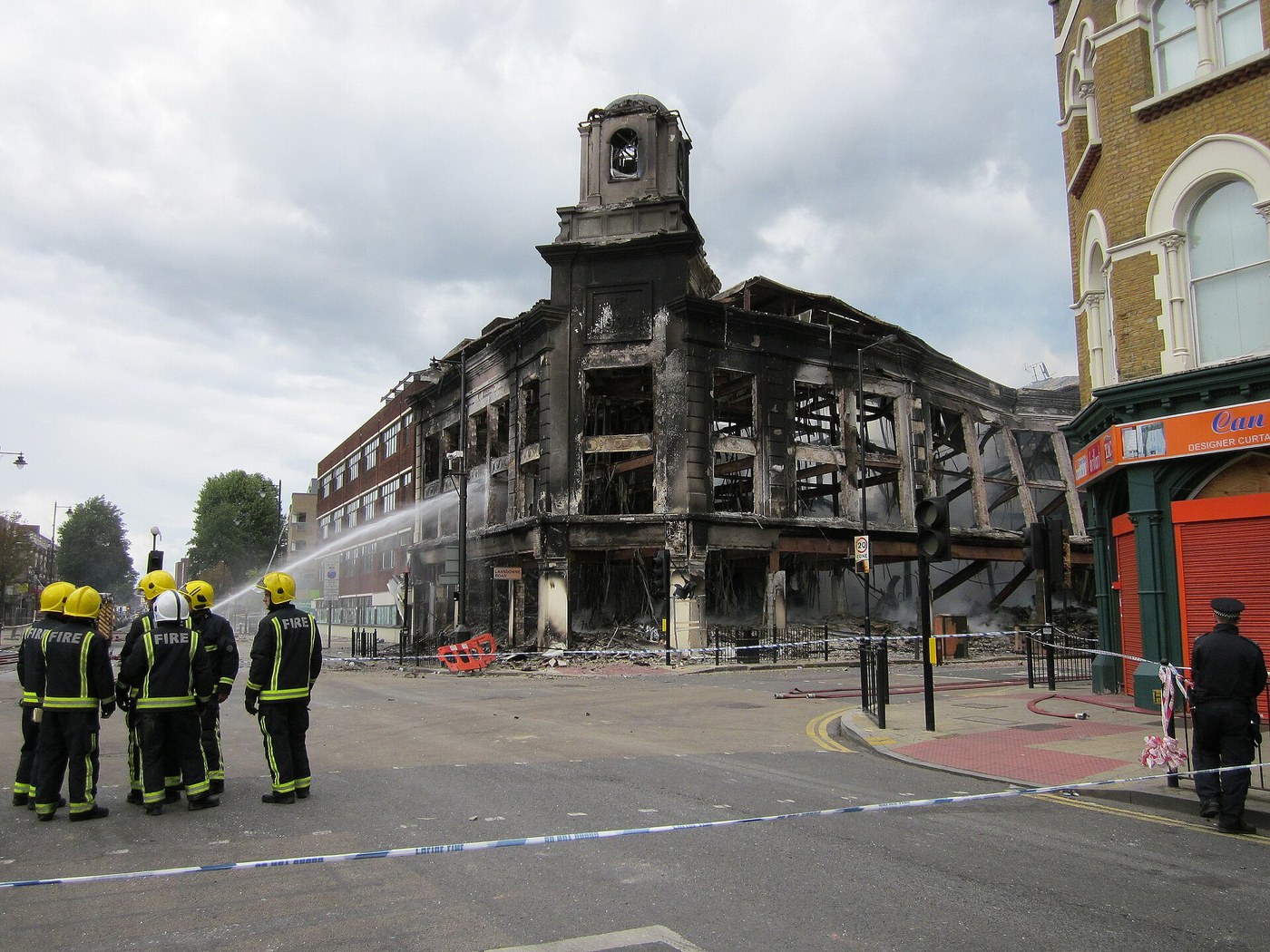
From the book
From Chapter Two: CharacterThe scale of the disorder matters but so too does its distributed character. Thousands took part across different cities, while messaging technology allowed people to coordinate and respond to police movements with unusual speed: to out-manoeuvre them; and to break violently with order, in acts like looting and arson, and by carrying out violence against the police and emergency services.
From the underlying research
The book works from published research. This is the paper the case rests on, in its own words.
Morrell, K., Heracleous, L., Fuller, C. and Bradford, B. (2020). ‘How Does the State Restore Order During Crisis? Lessons From the U.K.’s Response to the “Riots” of August 2011’, The Journal of Applied Behavioral Science.At street level, this involved the reassertion of sovereignty through territorial struggles by the police. At what we call “state level,” speech act theory helps us show how Members of Parliament framed the disorder and participants in ways that supported the reestablishment of norms and of order; principally through homogenization, in a process we describe as “tidying.”
Lenses
Questions to consider
- Which of the tasks your people face are genuinely impossible in this sense?
- What does your organisation require anyone to account for, in their own words, close to the moment?
- When your organisation tidies a complicated event into one category, who ends up outside the frame?
- What is your equivalent of putting on the helmet — an act that changes the situation it was meant to manage?
Where it is developed
Chapter Two: Character — the chapter carries the evidence and the close reading this page only points at.
Status: the passage from the book and the passage from the underlying paper above are quoted verbatim and checked against the source · surrounding context is site-written · author review required · no case facts introduced from outside the manuscript